Meet the professionals responsible for the experience, standards, and judgment behind Christian Defense Solution.
People do not know what they do not know
Choosing a Qualified Instructor
People seeking self-defense, medical, emergency-preparedness, or personal-safety training may not know what questions to ask—or how to recognize meaningful qualifications. A certificate may show that someone completed a course, but a credential alone does not demonstrate practical experience, sound judgment, or the ability to teach. Likewise, experience in a subject does not automatically make someone an effective instructor. A competent instructor should possess both subject-matter knowledge and the ability to help others develop safe, practical, and measurable skills.
When evaluating an instructor or training organization, look for:
Relevant and verifiable qualifications.Credentials should apply directly to the subject being taught and should be current when the issuing organization requires renewal.
Practical experience.The instructor should understand how the subject applies outside the classroom and be able to provide appropriate real-world examples.
Instructor-development training.Knowing how to perform a skill and knowing how to teach that skill are different abilities. A qualified instructor should understand lesson planning, communication, demonstration, practice, feedback, and learner assessment.
Clear training objectives.Students should be told what they are expected to know or perform by the completion of the course.
Safe and organized instruction.Training should progress in a controlled manner, account for student abilities, and place safety before speed, appearance, or ego.
Meaningful practice and feedback.Students should have opportunities to apply what they are learning through appropriate exercises, demonstrations, discussions, or realistic scenarios—and receive useful correction when needed.
Evaluation of learning.Attendance alone does not establish competence. A responsible instructor should use questions, observation, skill demonstrations, or other appropriate methods to determine whether learning has occurred.
Ethical and responsible judgment.Instructors in defensive and emergency disciplines should emphasize legality, restraint, avoidance, de-escalation, preservation of life, and knowing when not to act.
Respect for professional limitations.A trustworthy instructor clearly identifies what they are—and are not—qualified to teach and refers students to other professionals when a need falls outside their expertise.
Continued development.Competent instructors continue training, review changes within their fields, maintain appropriate credentials, and improve their programs using student feedback and updated information.
At Christian Defense Solution, we believe students deserve more than information. They deserve instructors who can explain, demonstrate, observe, correct, evaluate, and help them apply what they have learned responsibly.
Allie’s Christian faith is central to how he approaches leadership, service, family, and personal protection. He believes we have a responsibility to protect and care for the people God has entrusted to us while exercising wisdom, restraint, compassion, self-control, and good judgment. At CDS, he wants people to understand that being capable of defending yourself or others also carries a responsibility to know when—and when not—to act.
Biography
Allie is a United States Army veteran who completed his service at the rank of Sergeant (E-5). His military service, leadership experience, and years of working with individuals and families contribute to his disciplined but approachable method of instruction.
Allie began martial arts training in 2005 after watching his son, Dominiq, train. He holds 3rd Dan in Shōrin-ryū and 4th Dan in Motobu-ha Shitō-ryū. As owner and Chief Instructor of Shinsei Martial Arts & Fitness Center, he has extensive experience teaching martial arts, personal protection, character development, and responsible decision-making to children, adults, and families.
Allie is currently certified as a USCCA Firearms Instructor and USCCA Less Lethal Instructor. His CDS instructional areas include situational awareness, de-escalation, family preparedness, women’s self-defense, martial-arts-based personal protection, less-lethal defensive concepts, and general personal-safety education.
Beyond his technical qualifications, Allie brings valuable experience in mentoring, family guidance, and community leadership to CDS. Through Shinsei Martial Arts & Fitness Center, he has developed programs such as Boys to Men and Daughters of a King to help young people build character, confidence, discipline, faith, personal responsibility, and a stronger sense of purpose. As a family coach and author of The Parenting Dojo: How to Beat Your Kids (at the Game of Life), he has also helped parents and families address leadership within the home, healthy roles and boundaries, communication, conflict, and preparing children for adulthood. This experience strengthens CDS’s ability to address the human side of family protection—including judgment, relationships, emotional control, responsible decision-making, and creating a safer and more resilient family environment.
Co-Founder & Senior Instructor
Wesley K. Brown
Christian Belief & Faith
Wesley’s Christian faith is central to how he understands life and carries out his daily responsibilities. It establishes the moral boundaries of his service as a father, leader, teacher, protector, warrior, and scholar. Each role carries different responsibilities, but all are brought together by the same purpose: to serve God and neighbor, protect life, exercise restraint, and act with courage, wisdom, and moral responsibility.
Biography
Wesley brings approximately 44 years of instructional experience across military service, law enforcement, private security, emergency preparedness, martial arts, and civilian defense. He has served for approximately 25 years in Director of Training positions, conducting internal and external security assessments; developing workplace security, emergency, workplace-violence, and active-threat policies and procedures; creating emergency plans and tabletop exercises; developing instructors; and building practical courses for law-enforcement agencies, security organizations, businesses, and community clients. His professional security development includes ASIS training in facility security design and global terrorism.
His workplace-security work has supported major organizations, properties, and property-management portfolios, including Gannett and USA Today, AARP headquarters and satellite offices, the International Monetary Fund, the World Bank, the National Press Building and 700 North Capitol News Media Center, the Empire State Building, the New York City Teachers Union, the Baltimore Ravens stadium and Baseball Museum, Cuisine Solutions, Kansas City Harley-Davidson, CarrAmerica, Hines, Quadrangle, Equity, Lincoln Property Company, and Jones Lang LaSalle. Across these assignments, he has conducted or developed security assessments, emergency-management plans, policies and post orders, site-specific training, and emergency-response programs. At the Empire State Building, he taught a security emergency-response program to building security personnel. He has also supported government contractors whose identities cannot be publicly disclosed.
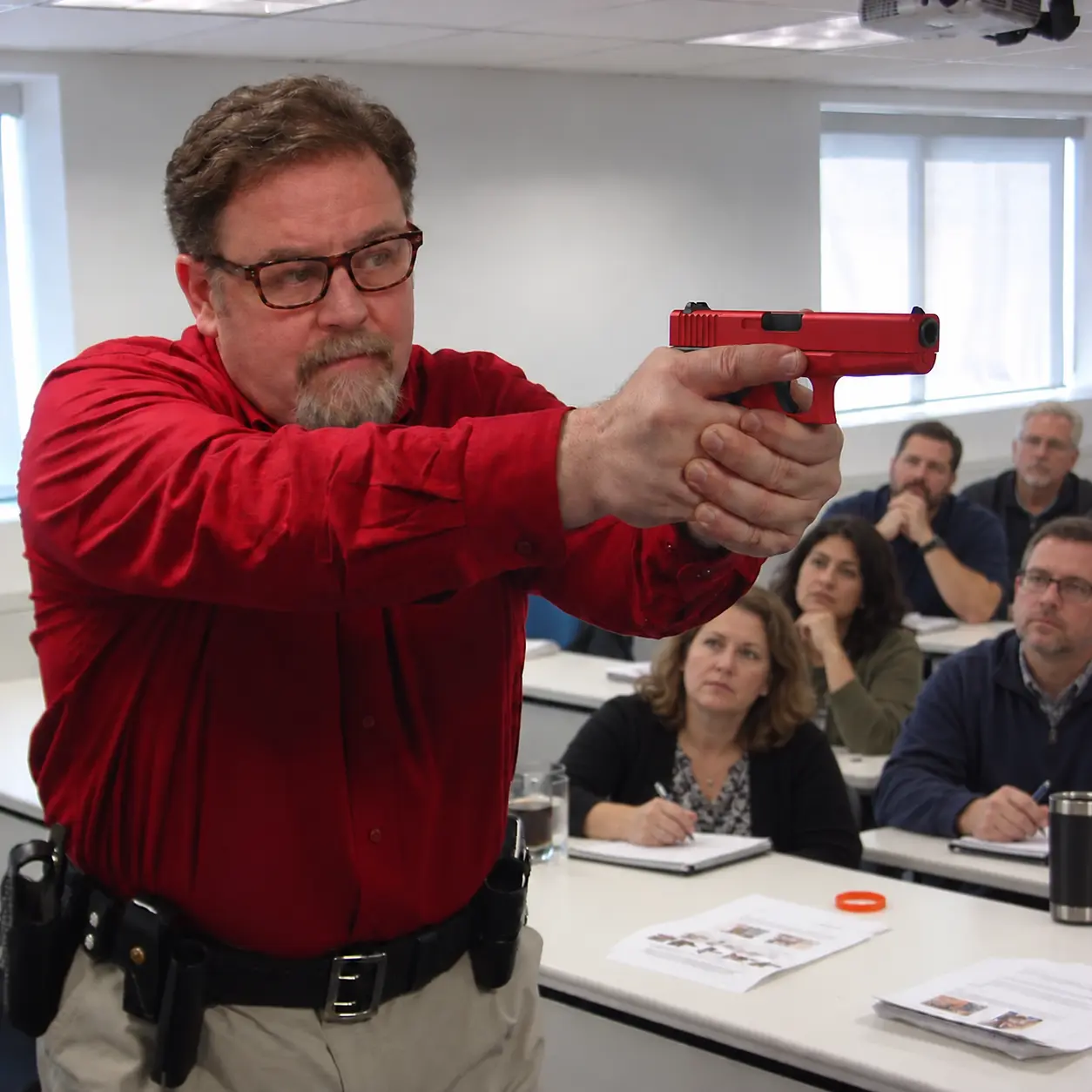
His current credentials include USCCA Firearms Instructor, USCCA Range Safety Officer, USCCA Less Lethal Instructor, and NRA Range Safety Officer. His documented professional background includes the 1997 Firearms Instructor School sponsored by the FBI Washington Field Office and the U.S. Department of Justice, along with previous NRA law-enforcement instructor credentials for handgun, shotgun, and patrol rifle. His additional instructor development includes Virginia DCJS firearms and defensive tactics, control tactics, private-security defensive tactics, ASP tactical baton, use-of-force decision-making, and less-lethal systems.
Wesley is an HSI Level 2 Instructor Trainer and an Active Shooter Training and AVIRT Instructor Trainer, with authorizations current through April 30, 2027. He is authorized to train and certify students in First Aid, Pediatric First Aid, CPR/AED for all ages, Basic Life Support, Advanced and Wilderness First Aid, bleeding control, bloodborne pathogens, emergency oxygen, and child and babysitting safety.
Wesley began martial arts training in 1978 and holds the title of Shihan and the rank of 7th Dan in Motobu-ha Shitō-ryū. His additional ranks and titles include 7th Dan in ISKU Kobudō, 3rd Degree in Goshin Jujitsu, 3rd Dan in Motobu Udundi, Okuden in Kamagata-ryū Iaido and Kobudō, and 2nd Dan in Mugai-ryū Iaido. He also serves as Florida Director for the International Seishinkai Karate Union.